The Padparadscha Sapphire : A sunset on the Indian Ocean

There are gemstones everyone knows, and others that remain a well-kept secret among gemologists and seasoned collectors. The padparadscha sapphire belongs to the latter category. This pinkish-orange sapphire, whose name comes from the Sinhalese padma radschen (lotus flower), is the only corundum to have been given a proper name in gemology. This fact alone speaks volumes about its unique status. The price of a padparadscha sapphire can range from a few hundred to several tens of thousands of euros per carat, depending on quality, origin, and whether it has undergone heat treatment. So, what justifies such a wide range? Which criteria drive the value of this exceptional gem up—or down? Here’s what you need to know before buying or reselling one.
What is a padparadscha sapphire?
The padparadscha sapphire, also spelled padparadja or padparadsha depending on sources and countries, is a variety of corundum, just like blue sapphire or unheated pink sapphire. Its chemical composition is identical to these gems: aluminum oxide (Al₂O₃) with traces of chromium and iron, which give it its unique hue somewhere between soft pink and bright orange. Its hardness is also the same: 9 on the Mohs scale, making it particularly well suited for everyday jewelry.
The general public discovered this gemstone in January 2018 when Princess Eugenie of York received a stunning engagement ring centered around a padparadscha sapphire surrounded by diamonds. The international circulation of this image propelled the gem into the spotlight—and with it, questions about its price.

A pinkish-orange corundum from the historic deposits of Sri LankaOriginally, padparadscha sapphires came exclusively from Sri Lanka, formerly known as Ceylon. Purists even consider that only gems mined on the island can legitimately bear this name. In recent decades, new deposits have been identified in Madagascar, Vietnam (Quy Chau district), Myanmar, and Tanzania. Tanzanian specimens, which are browner and less vibrant, are marketed under the name "African pad" and trade at significantly lower prices than those from Ceylon.The consensus rule remains this: beautiful color and high clarity outweigh geographic origin, even though Ceylon origin still commands a significant premium.The "sunset color": a definition debated among laboratoriesThis is where things become more complex. The hue of a padparadscha sapphire is difficult to define precisely, and the major gemological laboratories around the world do not all agree on the same colorimetric criteria. In the 1980s, theGIA (Gemological Institute of America) published a reference definition limiting padparadscha to light to medium pinkish-orange tones. The original Sinhalese definition is broader and includes more saturated hues reminiscent of a sunset (the famous sunset color).In practice, a stone that is too pink will be classified as a standard pink sapphire, while one that is too orange will fall into the orange sapphire category. Padparadscha thus occupies an extremely narrow color range. This is precisely what makes it so rare—and so expensive.

The four criteria that determine the price of a padparadscha sapphire
As with any gem-quality corundum, the value of a padparadscha sapphire is based on four fundamental criteria:
Color is the primary and most decisive factor: the balance between pink and orange must be precise, saturation moderate, and distribution even, without strong zoning.
Clarity: excellent transparency is essential. Inclusions visible to the naked eye or under 10x magnification significantly reduce value.
Cut: oval or cushion shapes are favored, with optimal proportions and well-balanced facets.
Carat weight: the exponential rule applies strongly here. Most padparadscha sapphires on the market weigh less than 2 carats. Beyond this threshold, they enter the realm of collector’s pieces.
To these four classic criteria is added a fifth factor specific to this gem: origin. A certified Sri Lankan padparadscha will always command a premium over a specimen from Madagascar or Tanzania, all else being equal.
Unheated vs. heated: a price gap that can triple
The issue of heat treatment is particularly decisive here. An unheated padparadscha sapphire ("no heat" or "unheated") can be worth three to five times more than a treated stone with similar characteristics. Heating involves exposing the stone to temperatures up to 1,800°C to improve color and reduce inclusions. This practice is legal and widely accepted in the trade, but it removes one of the most sought-after attributes in the collector’s market: the gem’s fully natural state.
For this reason, purchasing a valuable padparadscha sapphire must always be accompanied by a certificate from an independent laboratory explicitly stating the absence of treatment.
Pinkish-orange sapphire: padparadscha or simply a colored sapphire?

This question often arises, even among dealers and auction houses. Is a pinkish-orange sapphire automatically a padparadscha? The answer is no. The pinkish-orange color can appear in sapphires that do not fall within the strict color range defined for padparadscha. This is precisely where gemological certification becomes crucial—and also the main pitfall for inexperienced buyers.
How to distinguish a padparadscha from a standard pink sapphire
To the naked eye, distinguishing between an intense pink sapphire and a salmon-toned padparadscha can be challenging, even for a trained observer. The presence of a visible orange component, moderate saturation, and a luminous pastel tone are the most reliable visual indicators. However, this assessment remains subjective without laboratory analysis using UV-Vis spectroscopy or immersion microscopy.
TheSSEF (Swiss Gemmological Institute) and GRS (Gem Research Swisslab) are the two most respected laboratories for padparadscha certification. Their reports indicate not only probable geographic origin, but also color according to their own standards, and—most importantly—the presence or absence of heat treatment.
The gemological certificate: the ultimate authority
It must be said clearly: not all certifications are equal. Some organizations are very strict about the color definition of padparadscha, while others are more lenient and may certify pinkish-orange sapphires that would not meet GIA or SSEF criteria. This discrepancy is well documented within the international gemological community and represents a real risk for buyers.
Practical consequence: a sapphire presented as a "certified padparadscha" by a little-known laboratory should be approached with great caution. The value of a stone also depends on the reputation of the certifying body.
Padparadscha in high jewelry and luxury collections
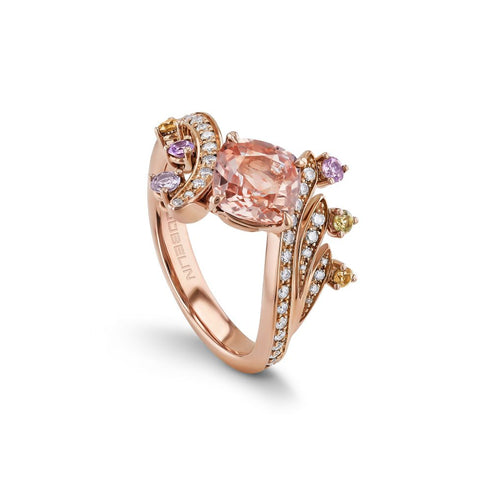
Gübelin Splendid Feather ring
The padparadscha sapphire has a long history in high jewelry. Cartier has set specimens of 22 and 24 carats in prestigious pieces. Chaumet, for its iconic Joséphine collection, created a ring featuring a cushion-cut padparadscha sapphire set in a diamond pavé. The Geneva-based house Gübelin has also highlighted it in its "Splendid Feather" collection. These examples illustrate that padparadscha is a gemstone reserved by the most demanding jewelry houses for their most ambitious creations, alongside unheated Burmese rubies and Kashmir blue sapphires.
Padparadscha in vintage jewelry: rarity within rarity
Finding a high-quality padparadscha sapphire is already difficult. Finding an antique piece—Art Deco or Belle Époque—set with a certified padparadscha is an even greater challenge. When such heirloom pieces reappear at auction at Christie’s, Sotheby’s, or Hôtel Drouot, they achieve high estimates. A documented provenance premium is added to the intrinsic value of the stone, something connoisseurs of antique high jewelry understand well.
Padparadscha as an investment: key signals to watch
An unheated padparadscha sapphire certified by GRS or SSEF, of Sri Lankan origin, is one of the most solid tangible assets in the colored gemstone market. The gradual depletion of Sri Lankan deposits, growing demand from Asia (Japan, China, Singapore), and the structural challenges of certification continue to put upward pressure on prices. For those seeking to diversify their wealth with alternative assets uncorrelated to financial markets, certified padparadscha represents one of the rare segments where demand and rarity work simultaneously in favor of the owner.
However, caution is needed: synthetic stones (produced by Verneuil or Czochralski processes) and lab-grown stones are entering the market at very low prices. Without certification from a recognized laboratory, no transaction should be considered.
The padparadscha sapphire is truly unique: the only gemstone to have been given its own name in gemology, and the only one whose color remains subject to interpretation even among experts. Its price, ranging from a few hundred to tens of thousands of euros per carat, reflects this singularity. Whether for an engagement ring, a collector’s piece, or an investment asset, purchasing a padparadscha requires the utmost care from an informed buyer.
At Les Pierres de Julie, in the Village Suisse in Paris, just steps from the École Militaire and the Esplanade des Invalides, a free appraisal of your padparadscha sapphire jewelry and gemstones is available—simply send photos to contact@lespierresdejulie.com
Nouveautés

- 2.600 €
- 2.600 €
- Unit price
- per

- 3.800 €
- 3.800 €
- Unit price
- per

- 9.000 €
- 9.000 €
- Unit price
- per

- 800 €
- 800 €
- Unit price
- per