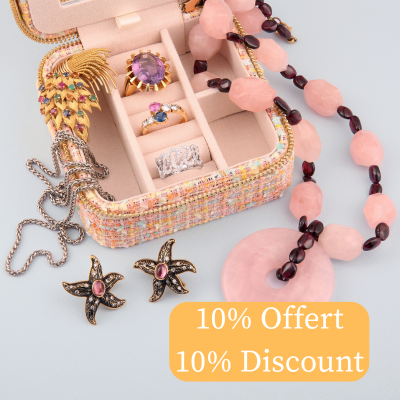
Quartz And Its Large Family

Quartz holds a unique place in the history of antique jewelry. Behind this single name lies an entire family of gemstones with remarkably different characteristics. Purple amethyst was regarded as a precious gemstone until the 18th century, while golden citrine continues to grace Cartier tiaras today. Rose quartz is associated with softness and romance, whereas smoky quartz is admired for its deeper, more dramatic tones. This diversity explains why so many civilizations—from the ancient Greeks to Japanese craftsmen—have attributed different powers and symbolic meanings to quartz. Learning how to identify a natural quartz, understand its true value, and choose an antique piece of jewelry that showcases it at its best requires a few key points, which this guide brings together for lovers of vintage jewelry and fine gemstones in Paris.
What Is Quartz? A Gemstone with Many Varieties
Quartz belongs to the silicate family and is composed of silicon dioxide, a mineral found on nearly every continent. Its abundance explains its enduring presence throughout the history of civilizations. In ancient Greece, the philosopher Theophrastus believed quartz to be ice frozen so intensely that it could never melt—a belief thought to have inspired the word "crystal," derived from the ancient Greek krystallos. In Japan, quartz symbolized purity and the patience of scholars, while in ancient Egypt it was associated with funerary rituals marking the passage of souls. Scottish and Irish folklore went even further, crediting quartz with the power to heal livestock. Beyond jewelry, quartz is also valued for its piezoelectric properties, making it an essential component in watchmaking and modern electronics, including smartphones and computers.

From a gemological perspective, quartz is one of the most widespread fine gemstones. With a hardness of 7 on the Mohs scale, it is durable enough for everyday wear in jewelry. Gemologists generally divide quartz into two main families, which are explored in greater detail in our article on the complete classification of quartz.
Macrocrystalline Quartz: Amethyst, Citrine, Rose Quartz and Smoky Quartz

Bolivian ametrine
This family includes the varieties most highly prized in jewelry. Amethyst owes its purple hue to traces of iron and was long regarded as a precious gemstone, ranking alongside ruby and emerald until the discovery of new deposits reclassified it as a fine gemstone. Citrine, whose color ranges from pale yellow to deep orange, is often produced by heating amethyst—a treatment that remains widespread on today's gemstone market. Rose quartz owes its delicate appearance to fine rutile inclusions, while smoky quartz, ranging from brown to nearly black, results from the natural irradiation of colorless rock crystal. Rock crystal itself remains the purest and most transparent variety, highly valued for its exceptional clarity. Ametrine, a bicolored variety combining the golden hues of citrine with the violet tones of amethyst, comes almost exclusively from Bolivian deposits and perfectly illustrates the geological continuity between these two gemstones.
Microcrystalline Quartz: Agate, Carnelian, Chrysoprase and Chalcedony

Chrysoprase and diamond bracelet, André Col workshop
This second family includes translucent varieties that have been used since Antiquity for intaglios and cameos, the art of gemstone carving that we have previously explored. Bluish chalcedony and orange carnelian are among the most widely used stones in antique jewelry, as their relative softness made them ideal for intricate engraving. Green chrysoprase and banded agate complete this family, which has long been favored by master engravers. One point deserves attention, however: a large proportion of the chalcedonies and chrysoprases available on the market today have simply been dyed to enhance what was originally a more subtle natural color.
The Main Quartz Deposits: Brazil, Madagascar and Auvergne
The world's most renowned quartz deposits are found in Brazil and Madagascar, while France's finest amethysts come from the Auvergne region. The Alps also boast a long-standing tradition of quartz mining: the Romans were already extracting crystals from what mineralogists now call alpine fissures, a practice that has been passed down from Antiquity to today's mineral collectors.
How Can You Tell Natural Quartz from Treated or Synthetic Quartz?

Dendritic agate, also known as landscape agate
This is a question we are often asked by customers considering the purchase of a quartz jewel: is the stone natural, treated, or simply synthetic? All three types coexist on today's market, and only a professional gemological examination can determine the answer with certainty.
The Main Quartz Treatments: Heating, Irradiation and Dyeing
Heating transforms amethyst into a gemstone resembling citrine. This practice is so widespread that most citrines sold today are the result of heat treatment rather than being mined as natural citrine. Irradiation darkens colorless rock crystal to produce smoky quartz with rich, deep tones. Dyeing is mainly applied to microcrystalline quartz varieties such as agate and chrysoprase, whose naturally subtle colors are intensified through the use of coloring agents. None of these treatments is deceptive in itself, provided it is clearly disclosed at the time of sale.
Inclusions That Help Authenticate a Gemstone: Rutile, Phantom Growth and Fluid Inclusions
A gemologist first examines the inclusions characteristic of natural quartz, which synthetic materials rarely reproduce accurately. These include golden rutile needles found in so-called Venus hair quartz, as well as phantom growth zones that reveal the successive stages of the crystal's formation. Tiny fluid inclusions trapped during crystallization also indicate the gemstone's natural origin. Examination under a gemological microscope, supplemented if necessary by a refractometer, is generally sufficient to distinguish natural quartz from a glass imitation. For valuable gemstones, however, certification from a recognized laboratory such as the SSEF remains the most reliable guarantee.
Quartz in Antique Jewelry: From Antiquity to the Art Deco Era
The Great Jewelry Houses and Quartz: Cartier, Boucheron and Collectible Citrines

Quartz has never been reserved for modest jewelry. It has long been featured in the collections of the world's most prestigious jewelry houses. Cartier created for Wallis Simpson a necklace combining amethysts and turquoise, which has become one of the iconic jewels of the 20th century. The Maison also designed a tiara set with citrines and diamonds, illustrating the period's fascination with colored gemstones mounted in platinum. Boucheron, for its part, combined citrines and diamonds accented with emeralds in its celebrated Hopi ring, where a hummingbird motif highlights the warm glow of the citrine. These creations demonstrate that an affordable gemstone can take center stage in a high jewelry masterpiece when exceptional craftsmanship and refined settings come into play.
Quartz in Art Deco and Retro Jewelry

The 1920s and 1930s marked a golden age for quartz in jewelry design. The geometric lines of Art Deco, a style we explore in greater detail in a dedicated article, paired beautifully with the clarity of rock crystal and the vivid hues of citrine and amethyst. Whether cut as cabochons or faceted gemstones, these stones emphasized the architectural design of the jewel rather than its brilliance alone. This distinctive aesthetic explains why brooches and rings from the Art Deco and Retro periods, often crafted in platinum or white gold, remain highly sought after by collectors of vintage jewelry.
What Is the Value of an Antique Quartz Jewel?

Wallis Simpson's Cartier necklace featuring amethysts and turquoise
Quartz Price per Carat: An Affordable Fine Gemstone
Compared with precious gemstones such as diamonds or sapphires, quartz remains an affordable fine gemstone, even in its finest qualities. Its value increases with the intensity of its color and the clarity of the stone, yet it bears little comparison to gemstones that historically occupied the same rank, such as amethyst before the 18th century. Rose quartz also shares its delicate pink hue with morganite, a pink variety of beryl whose value differs significantly, illustrating that similar colors do not necessarily translate into comparable prices. This affordability is precisely one of quartz's greatest attractions for anyone wishing to wear a colorful gemstone without investing in a high jewelry budget.
Investing in a Signed Jewel Rather Than the Gemstone Alone
It is important to be clear on this point: quartz alone does not represent a speculative investment comparable to gold or diamonds. The value of an antique quartz jewel almost always depends on other factors, including the maker's signature, the period in which it was created, and the quality of its setting. A Cartier necklace set with amethysts obviously bears little comparison, in terms of value, to an unsigned jewel featuring stones of similar quality. Anyone considering such a purchase from an investment perspective should always seek a professional appraisal to accurately position the piece within the vintage and estate jewelry market.
How to Choose and Care for a Quartz Jewel

A few simple criteria can help you choose an antique quartz jewel with confidence. For technical terms, you may also find our jewelry and gemology glossary useful.
Color and color saturation, which remain the primary factors determining value within a given quartz variety.
The type of cut: cabochon cuts for opaque or translucent stones, and faceted cuts for rock crystal and transparent quartz varieties.
The quality of the setting and the legibility of the hallmarks, which provide valuable information about the jewel's origin and period.
The presence of a gemological certificate, especially if the gemstone may have undergone treatment.
Caring for an Antique Quartz Jewel
With a hardness of 7 on the Mohs scale, quartz is well suited to everyday wear, although a few simple precautions will help preserve its beauty over time. Cleaning with warm soapy water followed by drying with a soft cloth is suitable for most quartz varieties—a recommendation also made by the GIA for rose quartz. Ultrasonic cleaning, however, should be avoided for dyed quartz or stones with significant inclusions, as vibrations may enlarge internal fractures. The same advice applies to rose quartz, whose delicate color may gradually fade after prolonged exposure to direct sunlight.
Where to Authenticate and Buy Antique Quartz Jewelry in Paris
Paris is home to several renowned destinations for authenticating or purchasing antique quartz jewelry, from the auction rooms of the Hôtel Drouot to the specialist boutiques of the city's antiques district. Located in the Village Suisse, just a short walk from the Eiffel Tower and the École Militaire, Les Pierres de Julie offers professional gemological expertise for quartz gemstones before any purchase or resale.
If you have questions about a quartz jewel you already own or about the pieces currently available in our boutique, our team offers a free appraisal, either in person at the Village Suisse or from photographs sent by email to contact@lespierresdejulie.com.
Quartz encompasses an extraordinary range of gemstones, from amethyst, once regarded as a precious stone, to the soft, delicate beauty of rose quartz. This remarkable diversity, combined with an accessibility that few gemstones can match, explains quartz's enduring presence throughout the history of jewelry, from ancient Egyptian funerary ornaments to the bold creations of the Art Deco era. When choosing a quartz jewel, the quality of the setting, the prestige of the maker's signature, and the story behind the piece matter far more than the gemstone itself. Even the finest quartz remains relatively affordable, making expert appraisal an invaluable step before any purchase or resale.
Nouveautés

- 8,500 €
- 8,500 €
- Unit price
- per

- 6,000 €
- 6,000 €
- Unit price
- per

- 850 €
- 850 €
- Unit price
- per

- 3,900 €
- 3,900 €
- Unit price
- per