Art Deco jewelry: a true signature in jewelry
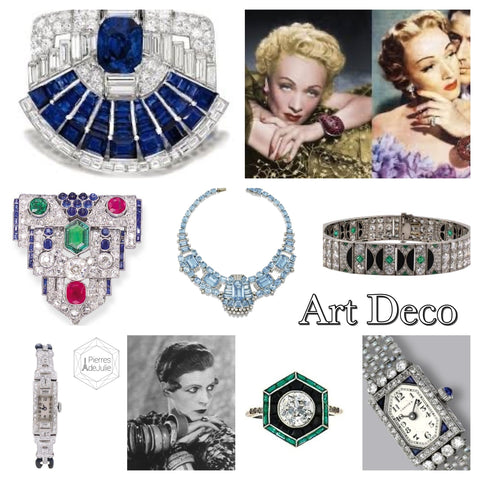
Art Deco jewelry holds a unique place in the history of fine jewelry. Emerging in the 1920s and remaining popular until the eve of the Second World War, it embodies an entire aesthetic philosophy built on rigorous geometry, platinum and white gold, calibrated gemstones, and precision stone-setting techniques. Art Deco jewelry broke away from the flowing curves of Art Nouveau, introducing bold lines, striking color contrasts, and a modernity that remains timeless. Rings, bracelets, brooches, and necklaces from this period remain among the most sought-after antique jewelry pieces on the market, particularly in Paris, where renowned maisons such as Cartier, Van Cleef & Arpels, and Boucheron produced some of their finest creations. Here is what you need to know to understand this style, recognize it, and purchase an Art Deco jewel with confidence.
The History of Antique Art Deco Jewelry

From the Battlefield to the Jeweler’s Workshop
The Art Deco movement officially began with the International Exhibition of Modern Decorative and Industrial Arts, held in Paris in 1925, from which the movement takes its name. However, its roots can be traced back to the early 1920s, when Europe emerged from a devastating war and sought a fresh start. The era of flowers and dragonflies beloved by Belle Époque jewelers was over. In their place came straight lines, sharp angles, and controlled power. Antique Art Deco jewelry is the child of this interwar period.
The movement flourished until 1939, drawing inspiration from a wide variety of sources. The rediscovery of Ancient Egypt, popularized by the Tutankhamun exhibition in 1922, introduced scarabs, lotus flowers, and hieroglyphics into the vocabulary of jewelers. Indigenous and tribal arts from Africa, the Americas, and Oceania contributed stylized forms and bold color combinations. Cubism, then at its height in painting studios, brought its geometric language into the display cases of Parisian jewelers.
Major Parisian Houses at the Forefront
Paris became the world capital of Art Deco jewelry. Cartier, Boucheron, Van Cleef & Arpels, Georges Fouquet, and Jean Després created pieces that redefined the art of jewelry. These houses did not simply follow trends—they created them. Van Cleef & Arpels developed the famous Mystery Set, an invisible setting technique in which the metal framework disappears entirely beneath the gemstones. Cartier popularized flexible platinum bracelets whose remarkable suppleness became one of the signatures of the period. Meanwhile, Danish jeweler Georg Jensen developed a more Nordic interpretation of the style from Copenhagen—less geometric, yet equally distinctive.
The Characteristics of Art Deco Jewelry: How to Recognize the Style

Geometry as a Visual Signature
The first thing that stands out in an Art Deco jewel is its precision. Designs are constructed with ruler-and-compass rigor: rectangles, diamonds, triangles, Greek-key motifs, and zigzags. This geometry is not cold—it is rhythmic, almost musical. Compositions are symmetrical and play with contrasts of value, texture, and color. Whether looking at a brooch or a cuff bracelet, this visual language is instantly recognizable.
The most characteristic motifs of Art Deco jewelry appear across creations from different houses: fan motifs (particularly common in drop earrings), geometric braids, bow motifs, rows of baguette-cut diamonds or sapphires, and onyx cabochons that punctuate compositions like bold black accents.
Preferred Metals: Platinum and White Gold
Yellow gold, highly prominent during the Belle Époque, took a secondary role during the 1920s. Cool-toned metals became dominant: first platinum, whose exceptional strength allowed for settings of unprecedented delicacy, and white gold, which appeared shortly before the First World War. These metals were ideally suited to filigree work—the delicate metal lace created by twisting and soldering fine gold or platinum wires—which interwar artisans elevated to extraordinary levels of refinement.
Platinum offered a decisive advantage to jewelers of the era: it allowed them to create tiny prongs and setting bars as fine as threads without compromising structural integrity. This made possible the diamond-covered compositions for which Art Deco jewelry is famous, where the metal becomes almost invisible and the gemstones take center stage.
The Gemstones Used in Art Deco Jewelry
The gemstones used in Art Deco jewelry follow two guiding principles: bold color and precise calibration. Unlike the previous era, in which individual stones dominated a design, Art Deco introduced calibrated gemstones, cut to exact dimensions in order to create continuous geometric patterns. Sapphires might be cut into baguettes to border a diamond-shaped motif, while emeralds could be fashioned into trapezoids to fit seamlessly within a fan-shaped composition.
The most commonly used gemstones in Art Deco jewelry include:
• Old-cut diamonds (rose-cut, Old European cut, or old single-cut diamonds), whose shallower faceting compared to modern brilliant cuts produces a softer, warmer light;
• Deep-blue sapphires, often cut into calibrated baguettes to create lines and borders;
• Emeralds, frequently cut as cabochons or emerald cuts, giving rise to the shape that still bears their name today;
• Onyx, carnelian, and chrysoprase, decorative stones that add black, orange-red, or green accents to colorful compositions;
• Synthetic gemstones, whose use became widespread during the interwar years due to the challenging post-war economic climate.
Rubies remained less common in Art Deco jewelry but nevertheless made memorable appearances. The famous Garter Bracelet created by Van Cleef & Arpels for Marlene Dietrich is perhaps the best-known example. The actress reportedly made the bracelet’s presence on set a non-negotiable condition of her participation in film productions.
Art Deco Jewelry as an Investment: What You Should Know Before Buying

Why Art Deco Jewelry Retains Its Value
The market for pre-owned Art Deco jewelry remains particularly resilient to changing trends, for several mutually reinforcing reasons. The first is the intrinsic rarity of these pieces: interwar techniques such as precision filigree, Mystery Setting, and gemstone calibration are difficult to reproduce on a large scale today, helping preserve the value of original creations. The second reason lies in the prestige of the maisons that defined the era. A Cartier or Van Cleef & Arpels piece from the 1920s or 1930s benefits from a brand premium that has consistently held its value over time.
The third factor is international demand, which extends far beyond traditional collector circles. Major Paris auction houses, led by Drouot, regularly achieve record prices for jewelry from this period, attracting buyers from Asia, the Middle East, the United States, and Europe alike. For a deeper understanding of the heritage value of antique jewelry, the article on investing in antique jewelry provides valuable insights.
Authenticity Criteria to Verify
Buying an Art Deco jewel requires knowing how to identify authenticity markers. The collector’s first tool is the hallmark, the stamp impressed into the metal that certifies both the alloy and, in many cases, the maker. On French platinum jewelry, collectors look for the platinum hallmark introduced in 1913. For 18-karat gold jewelry, the eagle’s head hallmark serves as the official guarantee. To learn more about reading hallmarks, the article Gold Hallmarks: A Guide to Buying with Confidence explains each mark in detail.
The second criterion is condition. An Art Deco jewel that has never been reset, recut, or remounted is generally worth more than a modified piece, even if the alterations were made with good intentions. Original settings, even when slightly worn, are a strong sign of authenticity. Buyers should also be cautious of pieces whose platinum components have been replaced with white gold. While technically possible, such modifications alter the feel, appearance, and value of the jewel.
Care and Preservation of Antique Art Deco Jewelry

Care Adapted to Period Materials
Art Deco jewelry often combines several materials—platinum or white gold, precious gemstones, decorative stones that may have been heat-treated, and in some cases synthetic gems—which requires a careful maintenance approach. The fundamental rule is gentleness: use lukewarm water and a mild soap, then allow the piece to dry naturally or pat it dry with a soft, non-abrasive cloth.
Ultrasonic cleaners, commonly used for modern jewelry, should be avoided on Art Deco pieces containing synthetic stones or glued cabochons. The vibrations can weaken the resins or cements historically used to secure certain elements. Platinum, meanwhile, develops a natural patina over time without oxidizing, which is one of its greatest qualities. This patina is normal and should not be systematically polished away, as it forms part of the jewel’s history.
Storage: An Often Overlooked Aspect
An Art Deco jewel should be stored away from direct sunlight and humidity in a jewelry box lined with natural, non-synthetic fabric. Hard stones such as diamonds and sapphires can scratch metals and other gemstones they come into contact with. For this reason, each piece should ideally be stored separately or in individual compartments.
For particularly valuable pieces, regular inspections by a certified gemologist are recommended. This helps ensure that settings remain secure, especially platinum prongs and bars which may have weakened slightly after more than eighty years. It is far better to identify a potential issue before a stone is lost.
Art Deco Jewelry and Other Major Jewelry Periods: Understanding Its Place
Art Deco and Art Nouveau: Two Opposing Aesthetics
The confusion between Art Deco jewelry and Art Nouveau jewelry is common, although the two movements could hardly be more different. Art Nouveau, flourishing between roughly 1890 and 1910, drew inspiration from nature: flowers, insects, women with flowing hair, snakes, and dragonflies. Its lines are organic, asymmetrical, and fluid. Art Deco, which followed, rejected these influences in favor of geometry, symmetry, and industrial modernity. Both periods frequently used the same gemstones—diamonds, sapphires, and emeralds—but in entirely different visual languages.
Art Deco and 1940s–1950s Jewelry: The Continuation of an Aesthetic Spirit
Art Deco established the foundations of a geometric aesthetic that later decades would reinterpret. 1940s jewelry, often described as Retro jewelry, retained the architectural rigor of Art Deco while reintroducing yellow gold, which became more practical than platinum during wartime shortages. The 1950s brought greater fantasy and renewed references to nature. To better understand this evolution, the article on 1940s and 1950s Jewelry provides an in-depth look at this transition.
Where to Buy Antique Art Deco Jewelry in Paris
Paris remains the world capital of Art Deco jewelry, and for good reason: the great houses that shaped this style established their workshops and archives there. The primary sources for acquiring Art Deco jewelry include auction houses (Drouot regularly organizes specialized antique jewelry sales), antique markets such as the Village Suisse in Paris’s 15th arrondissement, and specialized vintage jewelry boutiques.
The advantage of buying from a specialized boutique rather than at auction is twofold: expert authentication has already been completed, and buyers can examine the piece in detail, inquire about its provenance and condition, and even try it on before making a decision. At Les Pierres de Julie, located in the Village Suisse Paris, every Art Deco jewel offered for sale has been authenticated and appraised by a certified gemologist. The boutique also offers complimentary evaluations for anyone wishing to determine the value or authenticity of their jewelry.
Art Deco Jewelry: A Timeless Classic
Art Deco jewelry has passed through an entire century without losing either its appeal or its value, a testament to the enduring strength of its design. Its rigorous geometry and the technical mastery of the artisans who created it make these pieces equally attractive to collectors and everyday wearers. They are instantly recognizable—an Art Deco bracelet is unlike anything else—and durable enough for regular wear, which is not always the case with antique jewelry.
The selection offered by Les Pierres de Julie, located in the Village Suisse of Paris’s 15th arrondissement, is available both in-store and online at lespierresdejulie.com.
Nouveautés

- 6.900 €
- 6.900 €
- Unit price
- per

- 35.000 €
45.000 €- 35.000 €
- Unit price
- per

- 1.500 €
- 1.500 €
- Unit price
- per

- 3.900 €
- 3.900 €
- Unit price
- per