The Turquoise

Turquoise is one of the oldest gemstones worn by humanity. Its sky-blue colour, which may evolve towards green over time, has adorned jewellery since Ancient Egypt and the Persian Empire, long before the word turquoise entered the French language. An accessible gemstone in its common quality, it reaches considerable prices when it comes from the finest Persian deposits and is free from any matrix. Recognising a natural turquoise, understanding the treatments used to stabilise its colour and choosing an antique piece of jewellery that does it justice require a few precise guidelines, which this article brings together for lovers of vintage jewellery and fine gemstones in Paris.
What is turquoise? A blue gemstone steeped in history

Turquoise is a hydrated copper and aluminium phosphate, an opaque mineral with a cryptocrystalline structure that makes it both porous and sensitive to impacts. Its hardness, ranging between 5 and 6 on the Mohs scale, remains modest compared with quartz or sapphire, which explains the relative fragility of antique jewellery featuring this stone. This composition also explains its somewhat misleading name: the word turquoise comes from Turkey, a simple transit country on the trade route that connected Persia, the true producing region, to Europe.
Turquoise composition and colour: the role of copper
The characteristic blue colour of turquoise comes from the copper present in its structure, while greener shades often result from traces of iron or progressive dehydration of the mineral. The term "dead" or "faded" turquoise is sometimes used to describe a stone that has turned green, an inaccurate expression since a mineral does not die: the stone has simply dehydrated through contact with air, heat or oils.
The matrix, the natural signature of turquoise
The matrix refers to the fine brown or black veins running through certain turquoises, inherited from the host rock in which the stone formed. Gemmologists distinguish several patterns, from fine spiderweb matrix to complete absence of matrix, which corresponds to the most sought-after Persian stones. A turquoise with no visible matrix, displaying a deep and uniform blue colour, remains the ultimate benchmark on the market. This diversity of patterns explains why two turquoises extracted from the same mine can have a radically different appearance, making it difficult to assess a stone without professional gemmological expertise.
The main turquoise deposits: Iran, Sinai and North America
Iran remains the historical reference producer, with the mines of the Nishapur region having been exploited for nearly three thousand years for their almost matrix-free blue turquoise. Egypt also supplied turquoise from Antiquity onwards, extracted from the Sinai Peninsula. The American continent completes this geography today, between Mexico and several western US states, particularly Nevada and Arizona. These American deposits, discovered later, gave rise to a distinct identity: Native American jewellery set in silver rather than gold, which is now highly sought after by collectors.
How to recognise natural turquoise from treated turquoise?

The question often arises among clients considering the purchase of a turquoise jewel: is the stone natural, stabilised or entirely reconstituted? This porous and fragile gemstone is particularly suitable for treatments, making gemmological expertise essential before any significant purchase.
Stabilised, reconstituted or imitation turquoise: understanding the differences
Stabilisation consists of impregnating the stone with resin or wax in order to fill its porosity, which fixes the colour and makes cutting easier without altering the original natural turquoise. Reconstituted turquoise involves a different process, combining turquoise powder with synthetic resin, which places it among imitations rather than treated natural gemstones. The most common imitations remain dyed howlite and certain coloured glasses, which only a gemmological examination can distinguish with certainty.
Why turquoise sometimes turns green over time
Prolonged exposure to light and heat encourages the gradual dehydration of the stone, causing it to lose its blue colour and turn green. This natural phenomenon does not affect the authenticity of the turquoise and remains partially reversible through proper care.
Turquoise in antique jewellery, from pharaohs to Parisian jewellery houses
A gemstone worn since Ancient Egypt and Persia
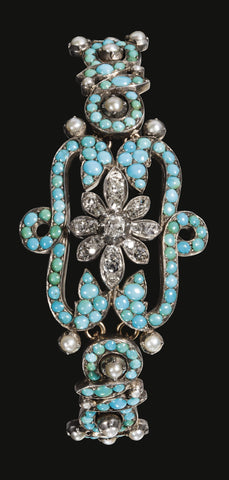
The pharaohs already wore turquoise on their crowns and pectorals, combined with lapis lazuli and carnelian in the characteristic colour palette of Egyptian goldsmithing. In Persia, the stone was used as a form of currency, while pre-Columbian civilisations saw it as a fragment of the sky fallen to Earth. The stone enjoyed similar popularity in India, where Mughal jewels frequently associated it with emeralds and rubies. Native American tribes of the southwestern United States also attributed ceremonial value to turquoise, wearing it as an amulet and crafting it into silver jewellery, a tradition that explains why turquoise remains the birthstone for the month of December today. Turquoise only arrived in France with the Crusades, several centuries after these early uses.
Cartier, Boucheron and Van Cleef & Arpels: turquoise in high jewellery

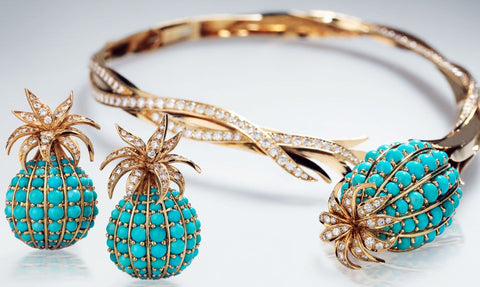
Common turquoise is mainly found in silver jewellery sold at affordable prices, as this stone remains widespread and inexpensive in ordinary qualities. The finest gemstones, however, have found their place both in Belle Époque jewellery and in 20th-century high jewellery. Cartier set turquoise and diamonds in a yellow gold ring dating from the 1960s, while Boucheron paired the same gemstone with sapphires in a creation from the 1980s. Van Cleef & Arpels, for its part, combined turquoise and diamonds in a complete parure enhanced with lapis lazuli, while jeweller Pierre Sterlé created famous yellow gold pieces set with turquoise.
What is the value of an antique turquoise jewel?

The price of turquoise per carat: a highly accessible gemstone
Turquoise remains one of the most affordable gemstones on the market in its common quality, which explains its widespread use in inexpensive silver jewellery. Its value rises considerably when the stone comes from the finest Persian deposits and displays no visible matrix, a sufficiently rare quality to justify prices approaching those of certain precious stones. Turquoise follows a similar logic to coral, an organic gem whose value also depends above all on the purity of its colour.
Investing in the signature rather than the gemstone alone
It is important to be realistic on this point: common turquoise does not, by itself, represent speculative value comparable to gold or diamonds. The market value of an antique turquoise jewel almost always depends on the signature of the jewellery house and the period of creation, well before the intrinsic quality of the stone. A turquoise ring signed Cartier obviously has nothing in common, in terms of value, with an anonymous jewel featuring a comparable stone. Before any purchase from a heritage investment perspective, an appraisal remains essential to determine the piece’s position on the jewellery resale market.
How to choose and care for a turquoise jewel?

Pierre Sterlé parure, yellow gold, turquoise and diamonds, circa 1950
A few simple criteria make it possible to confidently choose an antique turquoise jewel, with the help, if needed, of our jewellery and gemmology glossary for technical terms.
The colour and its uniformity, where a deep and consistent blue indicates a high-quality stone.
The presence or absence of matrix, which greatly influences the value of the stone.
The quality of the setting and the readability of hallmarks, which provide information about the origin and period of the jewel.
The existence of a gemmological certificate, especially when the stone may have been stabilised.
Caring for an antique turquoise jewel
Turquoise is sensitive to chemicals and perfumes, whose substances can attack its porous surface and dull its colour over time. A simple soft, slightly damp cloth is sufficient for daily care, and ultrasonic cleaning should never be used as it can weaken an already delicate stone. The GIA also recommends removing any turquoise jewellery before applying creams or during prolonged exposure to sunlight.
Where to authenticate and buy antique turquoise in Paris?
Paris is home to several leading destinations for authenticating or acquiring antique turquoise jewellery, from the auction rooms of the Hôtel Drouot to specialist boutiques in the antique dealers’ districts. Les Pierres de Julie, located at the Village Suisse, just steps from the Eiffel Tower and the École Militaire, offers gemmological expertise for these stones before any purchase or resale.
For any questions regarding a turquoise jewel already in your possession or pieces available in the boutique, our team offers a free appraisal, either on-site at the Village Suisse or through photographs sent by email to contact@lespierresdejulie.com.
Turquoise has travelled through the history of jewellery, from Ancient Egypt and the pharaohs to the great Parisian jewellery houses of the 20th century. This gemstone remains accessible in its common quality but increases greatly in value when it reaches the purity and absence of matrix sought after in Persian deposits. An antique turquoise jewel should above all be chosen for its setting, its possible signature and the story it carries. An expert appraisal is always recommended before a purchase or resale.
Nouveautés

- 1,990 €
2,800 €- 1,990 €
- Unit price
- per

- 2,400 €
- 2,400 €
- Unit price
- per

- 650 €
- 650 €
- Unit price
- per

- 6,000 €
- 6,000 €
- Unit price
- per