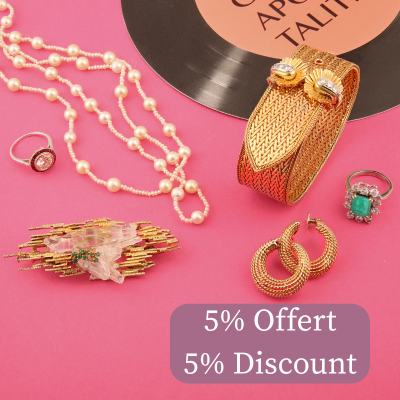
Investing in antique jewelry : a guide to make the right choice

While financial markets are riding a roller coaster and gold has just broken the historic $4,900-per-ounce mark, one question keeps coming up more and more often: should you invest in antique jewelry? Far from being a collector’s whim, antique jewelry has now established itself as a genuine alternative investment, halfway between a tangible asset and an object of passion. Unheated sapphires whose prices have increased fivefold over the past twenty years, exceptional rubies reaching record prices at auction, Art Deco jewels signed by the great maisons… The high-end antique jewelry market now attracts both seasoned enthusiasts and investors seeking portfolio diversification. So, safe haven or simple love at first sight? Let’s take a closer look at a world where rarity and authenticity rule.
Why antique jewelry appeals to investors

A tangible asset sheltered from economic turmoil
One only has to look at the price of gold to understand the appeal of precious materials in times of uncertainty. With an increase of over 175% over the past five years according to market data, the yellow metal confirms its status as a safe haven. And what about antique jewelry? It combines several advantages: the intrinsic value of its materials (18-carat gold, platinum, precious stones), enhanced by a historical and artistic dimension that a gold bar will never have.
Unlike stocks or bonds, an antique jewel cannot disappear with a click. You can hold it in your hand, admire it, wear it. It is capital in the most literal sense. And when markets panic and bank balances suddenly seem fragile, owning something tangible is reassuring. History’s greatest crises have proven it: gold and precious stones endure through the ages without losing their exchange power.
The growing rarity of exceptional pieces
This is something many people don’t realize: high-quality antique jewelry is becoming increasingly rare. Pieces from the 19th century or the Art Deco era are no longer being produced today. Historic deposits are being depleted, particularly for untreated stones. A Kashmir sapphire, a pre-war Muzo emerald, a Burmese “pigeon’s blood” ruby—these gems become harder to find on the market every year.
This structural rarity partly explains the spectacular price increases seen over the past two decades. Take high-quality blue sapphires, for example: their value has increased fivefold between 2005 and 2025. For exceptional untreated rubies, some estimates suggest a tenfold increase over the same period. As for Brazilian Paraíba tourmalines, discovered in the late 1980s, they have risen from around $2,000 per carat to over $15,000—or even $30,000 for the finest examples.
Investing in antique jewelry: which criteria should you consider?
The importance of provenance and authenticity
Not all antique jewelry is created equal. For a piece to gain value over time, several factors come into play. First, provenance: a jewel signed by a major house (Cartier, Van Cleef & Arpels, Boucheron, Boivin…) will always command a higher price than an unsigned piece, no matter how beautiful it may be. Then comes the period: Art Nouveau and Art Deco creations are particularly sought after, as are Belle Époque jewels or signed pieces from the 1970s.
Authenticity is also assessed through the state of preservation. A piece in its original condition, which has not undergone major alterations, retains more value than a modified jewel. Expertise certificates, especially for precious stones, also play a crucial role. A sapphire accompanied by a certificate attesting to its origin and the absence of heat treatment will be worth significantly more than a stone without documentation.
Stones currently in high demand

While not all gemstones evolve in the same way, some have clearly outperformed others. Here are the stones that have seen the strongest growth over the past twenty years:
-
Exceptional-quality ruby (unheated, Burmese origin): 2.5- to 5-fold increase depending on size and provenance
-
High-quality blue sapphire: 5-fold increase, and much more for Kashmir stones—auction results have shown increases of up to 100-fold for these
-
Lightly oiled or untreated Colombian emerald: estimated 3- to 6-fold increase depending on category
-
Brazilian Paraíba tourmaline: 7- to 15-fold increase
-
Tsavorite garnet: 6- to 8-fold increase
-
Spessartite garnet: 2- to 4-fold increase
-
Padparadscha sapphire: 3- to 9-fold increase for high-quality stones
These figures naturally concern top-quality stones. A small-caliber or heavily treated gem will not show the same performance, hence the importance of being guided by an expert before any purchase.
What you need to know about the taxation of vintage jewelry
Before getting started, a word about the taxation of vintage jewelry. In France, the resale of antique jewelry is subject to the precious objects tax. The rate is 6% of the sale price for jewelry, plus social contributions (CRDS), bringing the total to around 6.5%. For works of art, collectors’ items or antiques, the rate can reach 11%. Good news: you can opt for the real capital gains regime if you hold a purchase invoice. In that case, only the capital gain is taxed at 36.2%, with a 5% allowance per year of ownership beyond the second year. After 22 years, the exemption is total. This is yet another argument in favor of long-term investment.
Antique jewelry investment versus other asset classes
Antique jewelry vs physical gold: which strategy?
The comparison often comes up: why buy antique jewelry rather than physical gold in the form of bars or coins? Gold has the advantage of liquidity: easy to buy, easy to sell, and its price is quoted in real time. Antique jewelry, on the other hand, requires expertise to be properly valued and finds buyers in a more specialized market.
But that is precisely where its appeal lies. A well-chosen antique jewel offers greater appreciation potential than raw metal. While gold has risen by around 830% over the past twenty years, some precious stones have performed far better. Not to mention the dual use of jewelry: it can be worn, passed on, and enjoyed daily. Hard to say the same about a gold bar locked away in a safe!
A market driven by international auctions
Major auction houses confirm this trend. Sotheby’s achieved $270 million in jewelry sales in 2024, with spectacular results for antique pieces. An Art Deco necklace by Van Cleef & Arpels dating from 1929 sold for $3.6 million—three times its estimate. At Christie’s, signed jewels from historic maisons regularly set new records.
This momentum reflects the appetite of international collectors for prestigious antique jewelry. In France, according to Francéclat, production of jewelry in precious metals more than doubled between 2019 and 2024. And contrary to what one might think, this market is not reserved for the ultra-wealthy. Quality pieces, signed or not, remain accessible from a few thousand euros for those who know where to look.
How to successfully start investing in antique jewelry

Surround yourself with recognized experts
The first piece of advice—and probably the most important—is never to buy blindly. Antique jewelry is a highly specialized field where a trained eye makes all the difference. A specialized jeweler will know how to distinguish a period piece from a reproduction, assess the quality of a stone, and identify any restorations. In Paris, several experts and galleries are dedicated exclusively to this market.
For valuable precious stones, always require a certificate from a recognized laboratory. International laboratories such as SSEF, GIA or Gübelin, or in France the Laboratoire Français de Gemmologie, Gem Paris or Carat Gem Lab, are authoritative in this field. Their expertise guarantees the authenticity and characteristics of the gemstone—essential elements for any future resale.
Prioritize quality over quantity
One fine piece is better than ten mediocre ones. This golden rule applies to all passion investments, whether art, watches or jewelry. A high-end antique jewel, even if acquired at a high price, will retain its value and find a buyer when the time comes. An ordinary piece, purchased in the hope of a quick capital gain, is likely to disappoint.
Also think about intergenerational transmission. A family jewel, carrying history and emotional value, is a transferable asset your heirs will be proud to keep. That is the true magic of antique jewelry: it combines financial investment with emotional heritage.
Investing in antique jewelry requires careful thought, but the arguments are compelling. Spectacular increases in precious stone prices, growing rarity of exceptional pieces, and the solidity of gold: antique jewelry offers a convincing alternative to traditional investments—provided you prioritize quality and seek the right advice.
Note: jewelry market figures are constantly evolving. Those from early 2026, at the time this article was written, are of course subject to change. We strive to keep information on antique jewelry investment up to date. However, we strongly recommend that you always conduct your own research at the time you plan to invest. Feel free to contact us—we will be happy to support you throughout the process.
Interested in discovering our selection or having a family heirloom appraised? Visit Les Pierres de Julie, just steps away from the Eiffel Tower and the Village Suisse in Paris.
Nouveautés

- 13.000 €
- 13.000 €
- Unit price
- per

- 2.600 €
- 2.600 €
- Unit price
- per

- 3.800 €
- 3.800 €
- Unit price
- per

- 9.000 €
- 9.000 €
- Unit price
- per