Garnet : the red gemstone that keeps its secrets well

Garnet is often reduced to its red color, the one seen in Victorian rings and family heirlooms. This quickly overlooks the fact that this family of gemstones includes dozens of mineral varieties, some of which rival the green of emerald or the orange of imperial topaz. Almandine garnet, pyrope garnet, tsavorite garnet, demantoid garnet: each variety tells a different geological story and offers distinct optical qualities. Antique garnet jewelry, whether set in Victorian gold or mounted in silver during the Belle Époque, is experiencing renewed interest among collectors and vintage jewelry enthusiasts. And for good reason: at comparable quality, natural untreated garnet often remains more affordable than ruby, while delivering a visual result that easily rivals it.
Garnet: a much broader gemstone family than commonly believed

Garnet belongs to the broader family of gemstones. Its name almost always evokes red, yet this shortcut misrepresents the mineralogical reality of the gem. “Garnet” is actually a generic term referring to a group of silicate minerals whose basic chemical formula is [SiO4]4−, but whose color varies significantly depending on the associated elements. Iron produces shades ranging from brown to deep red, chromium generates intense greens, vanadium creates other green hues, and manganese gives rise to the brightest oranges in the family.
Two major groups are distinguished within this family: the pyralspites, whose color results from the presence of iron, and the calcium garnets, whose hues are due to so-called impurity elements. This distinction, though technical, has direct consequences on the market value and gemological interest of each variety.
Global garnet production spans all continents, with major deposits in East Africa (Tanzania, Kenya, Namibia, Madagascar), South Asia (Pakistan, India, Sri Lanka), and South America. Some varieties, such as demantoid from the Urals or uvarovite from Finland, are so rare that they supply only a very limited collectors’ market.
Pyrope and almandine, the most common red garnets
Pyrope is undoubtedly the garnet most often mistaken for ruby. Its fiery red color, due to the presence of chromium, gives it a very similar appearance to Burmese ruby, but its chemical composition based on magnesium, silica, and alumina leaves no ambiguity for gemologists equipped with a refractometer. Its wide availability explains its frequent presence in mass-market 19th-century jewelry.
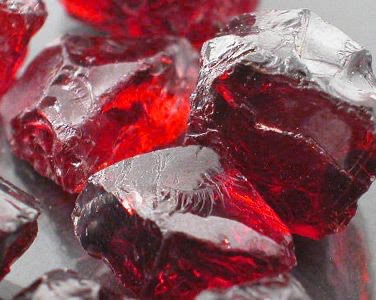
Almandine is an iron and aluminum garnet whose color range extends from brownish red to purplish red. It is often described as having a “wine color,” an image that perfectly captures the depth of its hue. Like pyrope, it is found worldwide and represents the most common variety on the antique garnet jewelry market.

Spessartite and hessonite: when garnet turns orange
Spessartite is a manganese and aluminum garnet whose highly saturated orange color sharply contrasts with the usual image of the gem. Its high brilliance gives it a sparkle appreciated by lovers of antique cuts, especially in richly faceted stones, and it is not uncommon in late Art Deco jewelry.

Hessonite belongs to the grossular subgroup, calcium and aluminum-based garnets. Its cinnamon color, sometimes tending toward honey brown, has earned it a prominent place in Indian subcontinent jewelry, where it has been used for centuries in traditional adornments.

Exceptional garnets: tsavorite and demantoid
Not all garnet varieties are equal in terms of rarity or market value. Among those that attract the greatest interest from collectors and gemstone investors, two stand out clearly.
Tsavorite: the untreated alternative to emerald

Tsavorite is a vivid green grossular garnet, named after Tsavo National Park in Kenya where its first significant deposit was discovered. Like emerald, it owes its color to traces of chromium and vanadium, but it has the advantage of not requiring the oil or resin treatments that emeralds almost always undergo. It is therefore a natural, untreated stone whose gemological traceability is easier to establish.
Tsavorite is now offered by major jewelry houses as an ethical alternative to emerald, particularly in contemporary settings. On the antique jewelry market, it remains relatively rare, as it was only discovered in 1967.
Demantoid from the Urals: the most valuable garnet variety

Demantoid is, in the opinion of gemologists, the most spectacular of garnets. It belongs to the andradite family and owes its brilliant green color to traces of chromium. Its most remarkable optical feature is its dispersion: this phenomenon, which allows rainbow flashes (“fire”) to be seen when the stone is moved, even surpasses that of diamond. This quality gives it a brilliance that rivals the finest gemstones.
Demantoids from the Ural deposits in Russia enjoy a special status. When the stone displays so-called “horsetail” inclusions (yellow chrysotile fibers arranged in a characteristic way), its value increases considerably: these inclusions act as a signature of origin confirming Ural provenance. The Gemological Institute of America (GIA) and the Swiss Gemmological Institute (SSEF) are the reference laboratories for the identification and certification of these stones.
Uvarovite

This green garnet, named after a Russian count and statesman, Sergey Semeonovich Uvarov, is very rare in gem quality and is therefore primarily a collector’s stone. Although it can be found in the United States, Mexico, Japan, and Russia, the only significant deposits are located in Finland. Its chromium-based composition gives it a color reminiscent of emerald, which is also colored by this element.
Antique garnet jewelry: from the Victorian era to Art Deco
Antique garnet jewelry forms a distinct chapter in the history of European jewelry. The stone accompanied major stylistic trends of the 19th and early 20th centuries, from Victorian adornments and Art Nouveau vegetal motifs to the geometric compositions of Art Deco.
Bohemian garnet: a star of Victorian jewelry
So-called “Bohemian” garnets (pyropes extracted from Bohemia, in present-day Czech Republic) reached their peak during the Victorian era. Set in closed settings or prong settings on brown gold or gilded silver, they adorned necklaces, mourning rings, and full parures passed down through generations. Their dark red, almost purplish color matched the period’s taste for sober yet intense aesthetics.
They are sometimes referred to as “Bohemian rubies,” a historically inaccurate term still found in some auction catalogs. Consulting the archives of Drouot reveals examples of these Victorian sets, some of which reach estimates far above their original purchase price.
From Art Nouveau garnet to Art Deco garnet
Art Nouveau (1890–1910) elevated garnet by incorporating it into nature-inspired compositions. René Lalique and his contemporaries paired red garnet with translucent enamel to create sophisticated inner light effects. Jewelry from this period—dragonflies and irises with gem-set petals—makes full use of the stone’s chromatic depth.
Art Deco, more geometric and restrained, favored cushion-cut or square-cut garnets set in platinum or white gold. Rings from this era often feature large almandine or pyrope garnets surrounded by old-cut diamonds, in settings highly sought after on the vintage jewelry market. To place these pieces in a broader jewelry context, our article on gold hallmarks provides essential guidance for authenticating period settings.
Buying natural garnet: how to avoid pitfalls
The gemstone market is not immune to counterfeiting, and garnet is no exception. Several elements help distinguish natural garnet from glass imitations or synthetic stones.
Here are the main signs to watch for when purchasing garnet jewelry:
An unusually low price should raise suspicion: no one sells a natural stone below market value, even during clearance sales.
The size of the gem is an indirect indicator: rare varieties such as demantoid or tsavorite rarely exceed six millimeters in diameter for gem-quality specimens.
Examination under a 10x loupe reveals characteristic inclusions of each variety, notably the horsetail inclusions in Ural demantoid.
The stone’s density, measurable by hydrostatic weighing, is an objective criterion any gemologist can verify.
The absence of UV fluorescence in almandine distinguishes it from ruby, which shows bright red fluorescence under ultraviolet light.
A certificate of authenticity issued by a recognized laboratory (GIA, SSEF, or Gübelin) remains the most reliable guarantee for high-value pieces.
For antique garnet jewelry, consulting a vintage jewelry specialist also helps assess the quality of the setting, the condition of the mounting, and the stylistic consistency with the claimed period.
Garnet as an investment: which varieties to watch?
Not all garnet varieties offer the same profile for buyers thinking in terms of long-term value. Pyrope and almandine garnets, widely available, are primarily decorative stones whose value depends more on the quality of the setting and the period than on the gem itself.
Ural demantoid, however, presents a rarity profile comparable to precious gemstones in investment terms. The historic deposits of the Nizhny Tagil region have been depleted since the early 20th century, making each pre-1914 Ural demantoid a piece with inherently limited supply. Auctions at Sotheby’s and Christie’s regularly feature Belle Époque jewelry lots containing Ural demantoids whose valuations far exceed those of other varieties.
High-quality tsavorite, untreated and certified, has followed a steady value trajectory since its discovery. Its natural rarity and lack of treatment make it a serious alternative to emerald for buyers concerned with ethics and traceability.
Garnet: a gemstone worth (re)discovering
Whether Bohemian red, Ural green, or Namibian orange, garnet is a gemstone of remarkable mineralogical richness, whose finest varieties deserve far more attention than their general reputation suggests. Les Pierres de Julie offers a selection of authenticated antique garnet jewelry at its boutique in the Village Suisse in Paris. For any questions about a piece you own or for a free appraisal, the boutique can be reached by email at contact@lespierresdejulie.com or directly at the Village Suisse, just steps from the École Militaire.
Would you like to see available pieces or have a jewel appraised?
Les Pierres de Julie welcomes you at the Village Suisse, Paris 15th district (near the École Militaire and the Esplanade des Invalides). For any request regarding a free appraisal, purchase, or resale, write to contact@lespierresdejulie.com or visit the website lespierresdejulie.com.
Nouveautés

- 1.200 €
- 1.200 €
- Unit price
- per

- 2.600 €
- 2.600 €
- Unit price
- per

- 21.000 €
30.000 €- 21.000 €
- Unit price
- per

- 5.950 €
- 5.950 €
- Unit price
- per