The Cameo: From Tradition To Modernity
The word "cameo" originates from the Italian "cameo" which means "camaïeu".

The word “cameo” originates from the Italian term “cameo,” itself related to “camaieu,” meaning a monochromatic artwork created with subtle variations of color.
The word “cameo” derives from the Italian cameo, itself originating from the term “camaieu,” a reference to the contrasting color layers that are characteristic of this delicate art form.
A cameo is the result of an ancient engraving technique known as glyptic art, practiced on hardstones or layered materials. This discipline encompasses two main types of carving:
intaglio, where the design is engraved into the material;
cameo carving, where the motif appears in relief against a contrasting background.
This opposition between relief and depth is what makes the cameo so distinctive. While intaglios were primarily used in Antiquity for seals and signets—where the impression appeared in relief when pressed into wax—cameos served mainly ornamental and symbolic purposes. Thanks to the natural layers found in certain stones, artisans could bring silhouettes, faces, and decorative scenes to life with remarkable precision.
Throughout the centuries, cameos have been used on a wide variety of objects: jewelry, rings, brooches, pendants, tiaras, as well as combs, cups, vases, belts, and even elements of armor and military helmets.
The History of the Cameo
The earliest known cameos date back to Hellenistic Greece before flourishing during the Roman Empire. Highly prized by the elite, they often depicted emperors, deities, mythological heroes, or religious scenes. The Romans excelled in the art of glyptic carving and frequently used naturally layered stones such as onyx, sardonyx, and carnelian to create striking visual contrasts.
Ancient cameos were true symbols of prestige and power. Some were even presented as diplomatic gifts or preserved within imperial treasuries. Among the most famous examples is the Grand Cameo of France, a Roman masterpiece preserved in the Cabinet des Médailles of the Bibliothèque nationale de France.
After a period of relative obscurity during the Middle Ages, the cameo experienced a significant revival during the Renaissance, fueled by Italian humanists’ fascination with Greco-Roman antiquity. European courts became captivated by these refined and scholarly objects.
The Great Revival of the Cameo During the Empire and the 19th Century
It was during the First French Empire that the cameo truly regained its former prestige. Fascinated by Ancient Rome, Napoleon Bonaparte made the Neoclassical style one of the defining symbols of his reign. Joséphine de Beauharnais, a great admirer of antique jewelry, also helped popularize cameos at the imperial court.
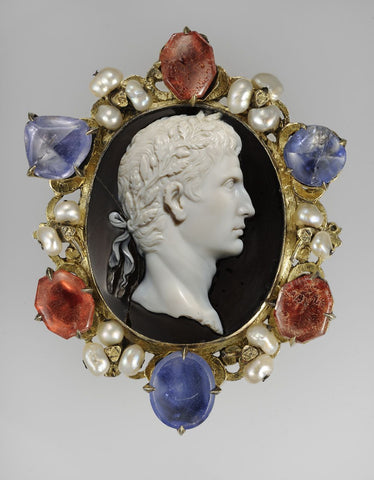
Napoleon actively encouraged this art form and founded a workshop dedicated to hardstone engraving in 1804 in order to revive French excellence in the field. Cameos soon adorned jewelry, crowns, official regalia, and fashion accessories worn by European elites.
Throughout the 19th century, particularly during the reign of Queen Victoria, the cameo became an essential element of Romantic jewelry. Women wore brooches, bracelets, and pendants featuring carved female profiles, mythological scenes, and floral motifs.

Yellow gold brooch, sardonyx and fine pearls, Napoléon III era
Faced with the immense popularity of these jewels, artisans gradually diversified the materials used in order to make cameos more accessible. Alongside traditional hardstones, new materials emerged:
shell,
lava from Mount Vesuvius,
coral,
ivory,
porcelain,
glass paste,
ceramic and molded glass.
The Italian town of Torre del Greco, near Naples, became one of the leading centers for the production of shell and coral cameos.
Materials Used in the Art of Cameo
A cameo can be carved from a wide variety of materials, provided they are sufficiently hard or feature multiple layers of color that create a natural contrast.
Among the most commonly used materials are:
Hardstones
onyx,
sardonyx,
carnelian,
agates,
chalcedonies,
jasper,
rock crystal,
amethyst,
garnet,
certain beryls such as aquamarine.
Organic and Volcanic Materials
shell,
coral,
ivory,
mother-of-pearl,
volcanic lava from Mount Vesuvius.
Decorative Materials Introduced in the 19th Century
porcelain,
glass,
glass paste,
ceramic,
certain modern resins.
Each material produces a unique aesthetic. Hardstones allow for extremely fine detailing, while shells offer soft, luminous contrasts that are particularly prized in jewelry making.
Some Famous Historical Cameos
Among the most iconic creations in the history of jewelry are:
Marie-Antoinette’s cameo and ruby bracelet by Mellerio dits Meller;

Napoleon’s crown adorned with antique cameos;

Joséphine’s malachite cameo parures;

and the prestigious Roman cameos preserved in European royal collections.
The Cameo Today: Between Heritage and Modernity
Long considered a classic or antique jewel, the cameo is now enjoying a genuine revival. In an era where vintage pieces, craftsmanship, and objects rich in history are increasingly appreciated, the cameo has naturally regained its place in contemporary fashion and fine jewelry.
From fashion runways to red carpets, cameos have reappeared, reinterpreted by leading luxury houses and contemporary designers.
Singer Katy Perry notably wore cameos at the ARIA Awards in 2014, while Rihanna, through Fenty, created a collection of oversized neo-cameos depicting Black women with braided hairstyles, blending classical heritage with a contemporary aesthetic.


Fashion houses are also reinventing this art form through the use of new materials and bold shapes. Lanvin combines resin, metal, and rhinestones, while Miu Miu modernizes the cameo through plexiglass and oversized volumes.


Today, the cameo appeals equally to lovers of antique jewelry and enthusiasts of contemporary fashion. Each piece tells a story and perpetuates a craft tradition that is more than two thousand years old.
If you are interested in cameo jewelry, feel free to explore the selection offered by Les Pierres de Julie.
We are also available to provide a free appraisal of your cameo jewelry. You may send photographs to the following address: contact@lespierresdejulie.com.
Whether you are interested in purchasing antique jewelry, gemstones, obtaining an appraisal, or selling your jewelry, Les Pierres de Julie welcomes you to its boutique nestled in the heart of Paris, within the Village Suisse, just steps away from the École Militaire and the Esplanade des Invalides.
Nouveautés

- 2.950 €
- 2.950 €
- Unit price
- per

- 7.500 €
- 7.500 €
- Unit price
- per

- 2.900 €
- 2.900 €
- Unit price
- per

- 3.900 €
- 3.900 €
- Unit price
- per