The Cameo: 2,000 Years of Engraved Stone

The cameo is one of the oldest jewels bequeathed to us by the history of jewelry. Born from the art of glyptic, the technique of carving layered stones in relief, it has endured through the centuries with remarkable consistency: appearing in the adornments of Roman emperors, Victorian brooches, and the runways of today’s leading fashion houses. Whether in the form of a brooch, pendant, or ring, the cameo comes in a multitude of shapes and is carved from materials as varied as onyx, sardonyx, shell, or coral. This article offers a comprehensive journey from the origins of the art of the engraved stone to its most contemporary reinterpretations, explaining why this exceptional jewel continues to fascinate.
Glyptic Art: The Art of the Engraved Stone
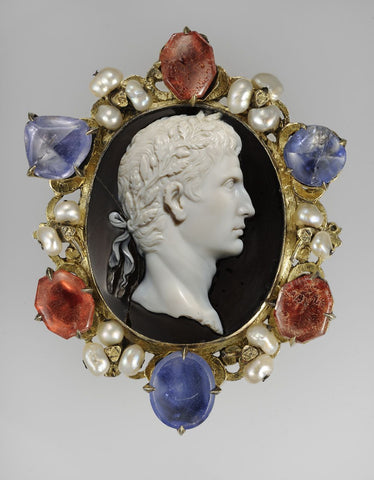
The word cameo comes from the Italian cameo, itself derived from the term camaïeu, a reference to the contrasting colors that characterize these pieces. It designates a very specific technique within glyptic art, the discipline encompassing all forms of engraving on hard stone.
Intaglio and Cameo: Two Opposite Approaches
Glyptic art produces two major families of objects, distinguished by their relationship to the material. In an intaglio, the motif is carved into the stone, allowing the ancient world to create raised impressions in the wax of seals and signets. In a cameo, by contrast, the motif stands out in relief against a contrasting background color, giving it a primarily ornamental and symbolic purpose. This opposition between recessed and raised carving defines the uniqueness of these two forms of gemstone artistry.
Materials: From Mineral to Organic
To be carved into a cameo, a material must either possess sufficient hardness or contain several layers of distinct colors that allow the artist to create contrast between the motif and the background. The most sought-after materials in antique jewelry are naturally layered stones, with sardonyx remaining the undisputed queen, but the list extends far beyond hard stones alone:
• Hard stones: onyx, sardonyx, carnelian, agate, chalcedony, jasper, aquamarine, amethyst
• Organic or volcanic materials: shell, coral, ivory, mother-of-pearl, lava from Mount Vesuvius
• Materials introduced in the 19th century: porcelain, glass paste, ceramic, molded glass
Each material produces a different effect: hard stones allow for extremely precise carving, while shell offers softer contrasts and a luminosity that was particularly prized in 19th-century jewelry.
The History of the Cameo: From Ancient Greece to Napoleon

Hellenistic and Roman Origins
The earliest known cameos date back to the Hellenistic period before experiencing unprecedented growth in Ancient Rome. Highly prized by the elite, they depicted emperors, deities, mythological heroes, and religious scenes, carved into layered stones such as onyx and sardonyx to maximize the visual impact of the relief.
These pieces served as true symbols of prestige and political power: they were offered as diplomatic gifts or preserved within imperial treasuries. The most famous surviving example is the Grand Cameo of France, a Roman masterpiece carved from five-layer sardonyx, measuring 31 cm in height and preserved in the BnF Museum. It depicts twenty-four figures arranged in three registers and remains the largest known ancient cameo.
The Renaissance and the Rediscovery of Antiquity
After a period of relative obscurity during the Middle Ages, the cameo experienced a powerful revival during the Renaissance, driven by the fascination of Italian humanists with Greco-Roman antiquity. European courts became passionate collectors of these scholarly objects, and Italian workshops emerged as their leading exporters.
The First French Empire and Neoclassicism
It was during the First French Empire that the cameo regained its full splendor. Napoleon Bonaparte, fascinated by Roman antiquity, made it one of the symbols of his reign and established a workshop dedicated to hard-stone engraving in 1804 in order to revive French excellence in the field. Napoleon’s crown adorned with ancient cameos and the parures of Joséphine de Beauharnais, a great admirer of antique jewelry, rank among the most iconic creations of the period. The Marie-Antoinette cameo bracelet by Mellerio dits Meller, created before the French Revolution, also demonstrates the long-standing tradition of cameos within French royal courts.


The Cameo in the 19th Century: A Golden Age and Widespread Popularity
Throughout the 19th century, particularly during the reigns of Queen Victoria and Napoleon III, the cameo became an essential feature of Romantic jewelry. Women wore jewels carved with female profiles, mythological scenes, and floral motifs, and demand eventually extended beyond the aristocracy to reach a rapidly growing bourgeois clientele.
To meet this enthusiasm, artisans diversified their materials and gradually made cameos more accessible. The Italian town of Torre del Greco, near Naples, became the world’s leading center for the production of shell and coral cameos, whose reputation remains intact to this day. Sardonyx brooches set with natural pearls, shell pendants mounted in yellow gold, and Napoleon III parures still found in Parisian antique shops all illustrate the richness of this production.
The Cameo Today: Between Heritage and Renewal
Long associated with a certain classicism, the cameo has enjoyed a remarkable revival in recent years. Renewed interest in vintage jewelry and traditional craftsmanship has introduced it to a wider audience than ever before, and it has naturally reclaimed its place in both fashion and collectible jewelry.

From the Red Carpet to the Great Fashion Houses
On fashion runways as well as red carpets, the cameo has reappeared in unexpected forms. Lanvin has combined it with resin, metal, and rhinestones, while Miu Miu has reinterpreted it in plexiglass and oversized proportions. Rihanna, through her brand Fenty, imagined a collection of XXL neo-cameos depicting Black women wearing braided hairstyles, where classical heritage meets a distinctly contemporary aesthetic.

Identifying and Authenticating an Antique Cameo
For those interested in purchasing an antique cameo, several criteria can help distinguish a high-quality piece from an industrial production. The finesse of the carving, the depth of the relief, and the consistency of the contrast between the layers are the first indicators to examine. A hard-stone cameo will always feel cooler to the touch than a shell cameo or a glass-paste cameo, and its surface will resist scratching with a fingernail. Examining the setting, often made of yellow gold or silver, can also provide valuable information about the period of manufacture. Surrounding borders of natural pearls and finely crafted prongs are characteristic of 19th-century pieces, particularly those found in major collections of antique brooches.
Which Cameo Should You Choose? A Buying Guide for Vintage Jewelry

Whether you are looking for a family brooch to restore, a pendant to wear every day, or a collector’s piece, choosing a vintage cameo follows a few simple guidelines. Hand-carved sardonyx and onyx cameos featuring pronounced relief and a perfectly uniform background represent the pinnacle of the craft. Pieces dating from the Napoleon III era, with their 18-carat yellow gold settings and halo-like borders of natural pearls, are especially sought after on the antique jewelry market.
Shell cameos from Torre del Greco, although less rare, remain beautiful examples of Neapolitan artisanal tradition, provided that the quality of the setting and the overall condition of the piece are carefully assessed. A cracked or chipped cameo loses a significant portion of its value, even when mounted in a precious metal setting.
Where Can You Find an Authentic Antique Cameo in Paris?

Whether considered a masterpiece of glyptic art or a collector’s item, the antique cameo brings together two thousand years of jewelry history and a level of craftsmanship that few techniques can rival. Its continued presence in contemporary fashion collections confirms that it has lost none of its enduring appeal. Les Pierres de Julie offers a selection of authenticated antique cameos and vintage jewelry at the Village Suisse in Paris, just a short walk from the École Militaire. For a complimentary appraisal of your cameo jewelry, please write to contact@lespierresdejulie.com.
Nouveautés

- 35.000 €
45.000 €- 35.000 €
- Unit price
- per

- 1.500 €
- 1.500 €
- Unit price
- per

- 3.900 €
- 3.900 €
- Unit price
- per

- 4.900 €
- 4.900 €
- Unit price
- per